| On This Page 1. How Cleaning Services Apps Work 2. Recurring Bookings: The Engine of the Business 3. Team Management: Scheduling, Dispatch, and the Cleaner App 4. Quality Scoring: Turning Trust Into a System 5. The Tech Stack and Architecture (2026) 6. Cost, Timeline, and Building It in India 7. Real Case Study: A Recurring, Two-Sided Marketplace 8. Best Practices and Common Mistakes 9. FAQs |
Summary
Workforce data from the US Bureau of Labor Statistics shows how large and people-heavy the cleaning sector is, which is exactly why software that coordinates people, not just bookings, is what wins.
This article is a deep dive into those three systems, written from real delivery experience rather than generic, scraped advice. We will explain how the model works, go deep on recurring bookings, team management, and quality scoring, then cover the stack, the cost, and a real client build so the advice stands on shipped work. It sits inside our wider on-demand app development guide on acquaintsoft.com. Read it the way an operator would: asking whether this app could run a hundred cleaners next quarter.
How Cleaning Services Apps Work
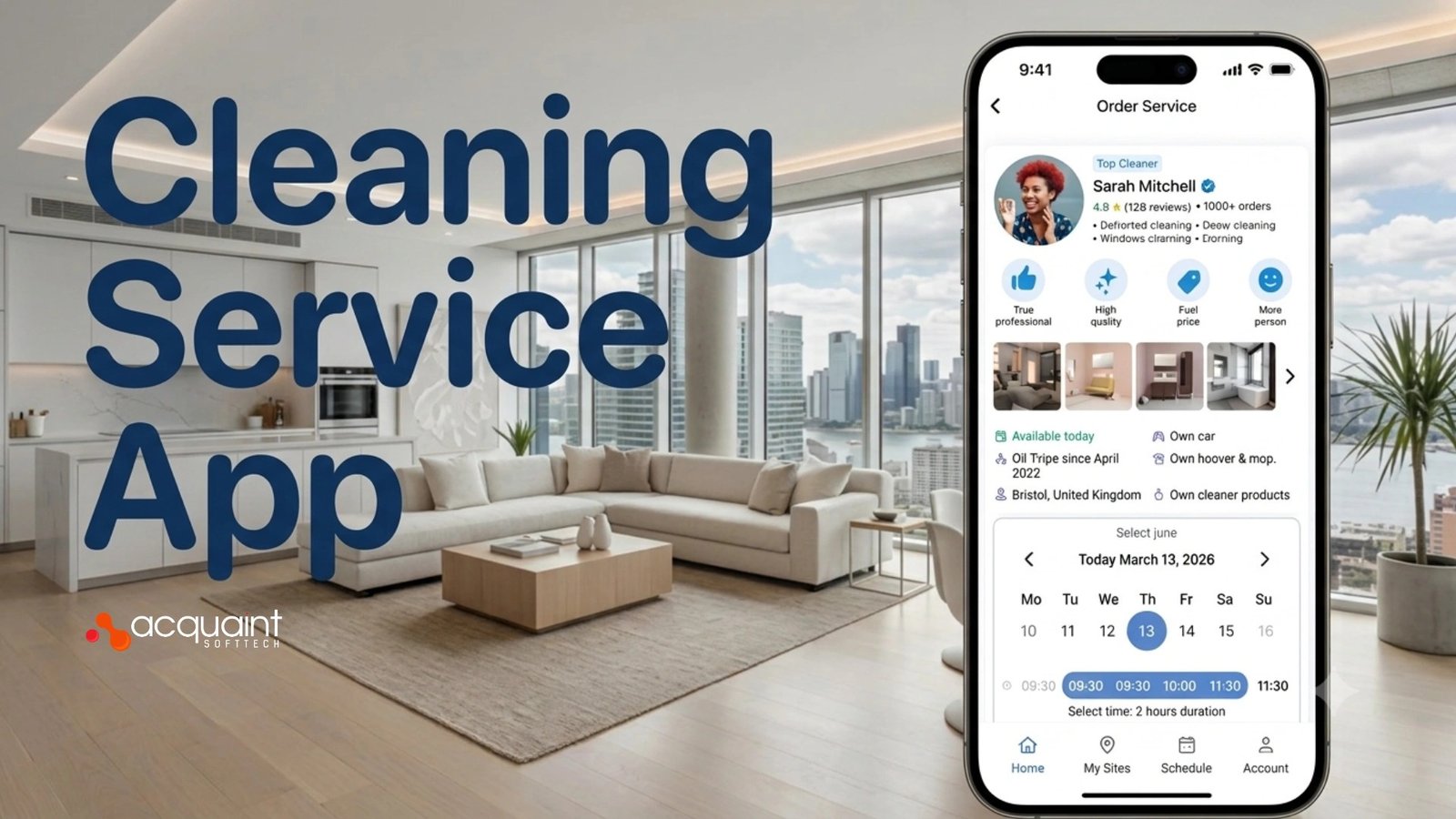
A cleaning services app is a two- or three-sided marketplace that connects customers, cleaners, and an admin team, handling discovery, booking, scheduling, payment, and ratings in one flow. The Handy and Urban Company model is simple to state: a customer books a cleaning, the platform assigns a vetted cleaner, the job is done and rated, and the platform takes a commission.
The difficulty is everything beneath that one sentence, which is why serious operators treat it as a real product and bring in software development outsourcing partners rather than buying a template. Get the model right, and the features finally have somewhere solid to live.
The Handy business model in one view
Most platforms run one of two models: a managed marketplace that vets, schedules, and pays cleaners directly, or a lead-generation model that simply connects customers to independent providers.
Each choice changes your pricing, your liability, and your software, a distinction we unpack in our on-demand home services app guide. Cleaning leans toward the managed model, because a customer is letting a stranger into their home and wants the platform to stand behind quality. That trust requirement quietly shapes every later decision.
Before any feature is built, the model and market have to be pinned down: managed or lead-gen, home or commercial, one city or many, employees or contractors. Each answer cascades into the booking engine, the payment flow, and the legal setup, so we map it in a discovery workshop first. A cleaning app for fifty cleaners in one city is a different product from a national platform. Deciding this early is the cheapest decision you will ever make.
Recurring Bookings: The Engine of the Business
Recurring bookings are the single most important feature in a cleaning app, because cleaning is a habit rather than a one-off, and recurring revenue is what makes the business viable. A customer should be able to book the same cleaner every week, every fortnight, or every month, with automatic scheduling, reminders, and payment.
Building a reliable recurring engine, with edits, skips, and pauses, is real backend work, which is why teams hire Laravel developers to get the scheduling and billing logic right. One-off bookings are a demo; recurring bookings are a business.
What a recurring engine must handle
• Flexible cadence: weekly, fortnightly, or monthly schedules a customer can change.
• Same-cleaner preference: the loyalty that keeps customers from churning.
• Skip, pause, and reschedule: real life, handled without a support ticket.
• Automatic recurring payments: charges, prorations, and retries on failed cards.
• Reminders and confirmations: so neither side forgets a scheduled clean.
The hardest part is money. Recurring bookings mean recurring charges, prorations, failed-payment retries, and refunds when a clean is cancelled, all of which depend on a payment platform chosen for subscriptions rather than one-off checkout.
Recurring logic is also where cheap clones break first, because a template built for single bookings cannot cleanly express skip this week, change my cleaner, or pause for a month. Bolting that on later usually means a painful version upgrade or a full rewrite. Designing the recurrence model properly at the start is far cheaper than retrofitting it. Treat recurrence as the core, not a setting.
Team Management: Scheduling, Dispatch, and the Cleaner App
Team management is what separates a cleaning marketplace from a booking form, because the product only works if the right cleaner is in the right place at the right time.
The platform needs a cleaner app for jobs, schedules, navigation, and check-in, plus an admin dispatch view that assigns work, tracks availability, and handles no-shows. Building that operational layer reliably is the focus of our dedicated development teams. A booking nobody is assigned to is just a complaint waiting to happen.
The cleaner app and the dispatch view
• Job list and schedule: today’s and upcoming cleans, clearly laid out.
• Availability and accept or decline: cleaners control when they work.
• Navigation and check-in or out: arrive, start, and finish with timestamps.
• Photo proof of work: evidence that protects both sides.
• Admin dispatch and reassignment: cover a no-show before the customer notices.
The coordination problem is the same one every on-demand platform faces: matching supply to demand in real time and recovering gracefully when something slips, which we walk through in our on-demand delivery app development guide. Cleaning adds its own twists, like longer jobs, recurring same-cleaner ties, and travel time between homes. The schedule is a living thing, not a static calendar.
The cleaner app lives on a phone in someone’s pocket between jobs, so it has to be fast, simple, and reliable on mobile data. Cross-platform delivery keeps it affordable, which is why teams hire React Native developers to ship the cleaner and customer apps together. A confusing cleaner app means missed check-ins and unhappy customers. Build for the person standing on a doorstep, not the office.
Quality Scoring: Turning Trust Into a System
Quality scoring is how a cleaning platform turns trust into a system instead of a hope, and it is what protects the brand when a stranger is cleaning someone’s home. A good scoring model blends customer ratings, completion and punctuality data, photo proof, complaints, and rebooking rate into a single, fair signal per cleaner.
Modern platforms use that signal to reward top cleaners and flag risky ones early, often with AI development services spotting patterns a human would miss. A star rating alone is not a quality system.
What goes into a fair quality score
• Ratings and reviews: the customer’s direct verdict on the clean.
• Punctuality and completion: did the cleaner arrive and finish on time?
• Photo evidence: before and after proof for disputes.
• Complaint and refund rate: the clearest signal of a real problem.
• Rebooking and cancellation rate: whether customers want this cleaner again.
A score is only as trustworthy as the data behind it, so every event has to be captured cleanly and weighted sensibly, the same data discipline behind the platforms in our Laravel project case studies. A score that punishes a cleaner for a customer’s bad behaviour, or rewards a lucky streak, destroys the trust it was meant to build. Fairness is an engineering requirement here, not a nicety.
This is also where smart platforms pull ahead of clones, by predicting which jobs are at risk, which cleaners need coaching, and which customers are about to churn. Teams building that layer often hire Python developers for the data and modelling work. A quality score that quietly improves your whole supply is worth far more than a number next to a name. Make the score do work, not just decorate a profile.
The Tech Stack and Architecture (2026)
A 2026 cleaning services app pairs cross-platform mobile apps with a real-time backend, a scheduling and billing engine, and a database built for recurring events. React Native or Flutter cover the customer and cleaner apps; a Node.js or Laravel backend runs bookings, recurrence, payouts, and scoring; and live dispatch updates ride over WebSockets and push. Many teams build on a single JavaScript foundation, so founders hire MERN stack developers who can own the customer, cleaner, and admin apps together.
| Layer | Recommended Tech | Role |
| Mobile apps | React Native / Flutter | Customer and cleaner apps |
| Backend | Node.js / Laravel | Bookings, recurrence, payouts |
| Real-time + jobs | WebSockets, schedulers | Dispatch, reminders, retries |
| Data + cloud | PostgreSQL, Redis, AWS | Scoring, scale, uptime |
Why architecture beats any framework
Architecture matters more than any single library you pick. A cleaning platform is an event-driven system juggling recurring schedules, real-time dispatch, and a scoring pipeline, all of which must survive a busy Saturday morning.
The backend choice between a PHP and a JavaScript stack is a genuine trade-off, which we weigh in Laravel vs MERN stack. Pick for your team and your scale, not for whatever is trending this quarter.
The unglamorous layer is operations. Recurring jobs run on schedules, payments retry on timers, notifications must fire reliably, and the whole system needs monitoring and autoscaling for peak demand. Strong DevOps engineers are what keep recurring bookings from silently failing at 6 am. The scheduled job nobody is watching is the one that quietly breaks the business.
Read Also: How Furniture Removalists in Ballarat Protect Your Valuable Belongings During a Move
Cost, Timeline, and Building It in India
A focused cleaning app MVP, with one city, recurring bookings, a cleaner app, and basic scoring, typically starts in the mid-five figures, while a full multi-city platform with advanced dispatch and analytics runs into six figures.
Timelines follow the same curve: a few months for an MVP, longer for a scaled platform. Teams keep both under control by hiring remote developers on a flexible model instead of carrying a fixed local payroll before revenue exists.
| Build | Typical Cost | Timeline |
| MVP, one city | From ~$30,000 | 3 to 5 months |
| Growth platform | $70,000+ | 5 to 8 months |
| Multi-city, full features | $130,000+ | 8 months and up |
Why building in India changes the maths
Geography is the biggest single lever on what you spend. India-based teams deliver the same quality at up to 40% lower cost than Western agencies, the saving documented in our story on how a startup saved $60K a year on remote hiring. For a home-services app, that gap often funds the cleaner app or the scoring engine that makes the platform whole. Cheaper hours buy a more complete launch.
Cost is also a function of the decisions made before any code is written. A wrong architecture or a recurrence model bolted on late can cost more than the original build to fix, so senior guidance early pays for itself. A virtual CTO can set the scope, the stack, and the hiring plan before money is committed. Spend on judgement first, code second, and the rest gets cheaper.
Real Case Study: A Recurring, Two-Sided Marketplace
The clearest proof of how we build a recurring, two-sided service marketplace is Gowd, a subscription-sharing platform we built for the US market, documented in our Gowd case study.
Like a cleaning app, it connects two sides, buyers and sellers, through one secure platform, runs on a recurring monetisation model, and lets users find and book what they need through robust search and clear listings. We built it custom on a Python and AWS backend so the recurring, marketplace logic could scale cleanly rather than buckle.
Why it maps onto a cleaning app
The shared foundation is exactly what a cleaning marketplace needs: a secure two-sided platform, a recurring revenue model, frictionless onboarding through social login, and listings that make finding the right option effortless.
Swap a shared subscription for a recurring clean and a seller for a cleaner, and the architecture is the same. These are the disciplines verified clients praise, summarised in our Clutch recognition overview, and you can browse more delivered work on our case studies page.
| Capability | What we built for Gowd | Cleaning app equivalent | |
| Two-sided marketplace | Buyers and sellers, secure | Customers and cleaners | |
| Recurring model | Up to 70% seller commission | Recurring bookings and payouts | |
| Onboarding | Social login (Google, Apple) | Fast cleaner and customer signup | |
| Robust search and listings | Find and book the right cleaner | ||
The lesson for a cleaning platform is that recurring, two-sided products live or die on a custom backend you own and can extend, not a template you rent. A live cleaning app also needs steady support and maintenance to keep recurring jobs, payouts, and scoring running cleanly after launch. Recurring revenue depends on recurring reliability.
Best Practices and Common Mistakes
Cleaning apps fail in predictable ways, and almost none of them are about how the app looks in a pitch deck. The biggest mistake is launching one-off bookings and treating recurrence, team management, and quality as later additions, which guarantees an expensive rebuild. Avoiding that needs discipline and someone guarding the scope, which is why a strong project manager is worth more than any single feature on a busy build.
Get these right, avoid these traps
• Do: design recurrence and same-cleaner ties from day one.
• Do: build a real cleaner app, not just a customer app.
• Do: make quality scoring fair and data-driven.
• Avoid: a Handy clone that cannot handle recurring schedules.
• Avoid: launching with empty cleaner supply, the cold-start trap.
Choosing the right partner is the decision behind all the others. An experienced team designs for recurrence, dispatch, and trust from the start- the difference our roundup of the best software product engineering companies explains in depth. The cold-start problem, an app with no cleaners, is a strategy issue as much as a software one. Plan supply before you plan marketing.
There is a faster route that is not a throwaway clone. A properly engineered white label solution you own and customise can give speed without the template trap, when built by a team that understands service operations. The right route depends on your timeline, budget, and ambition, which is the conversation worth having before a line of code is written.
FAQs
How does Handy work?
Handy works as a managed cleaning marketplace that connects customers with verified cleaners. Customers book a service, a cleaner is assigned, and payment is processed through the platform. The service is completed, rated, and the platform earns a commission from each booking.
How to build a cleaning services app?
Start by defining your service model, target market, and service area. Build core features like booking, cleaner dispatch, payments, and recurring scheduling. Launch an MVP in one city, validate demand, and scale gradually.
How much does a cleaning app cost?
Cleaning app development costs depend on features, integrations, and scalability requirements. A basic MVP costs less than a multi-city platform with advanced automation. India-based development teams can reduce overall costs by up to 40%.
| US Cost | UK Cost | Europe Cost |
| $30,000–$130,000+ | £24,000–£104,000+ | €28,000–€122,000+ |
How to manage cleaning teams in an app?
A cleaner app helps teams manage schedules, job assignments, and attendance. Managers can monitor availability, track progress, and reassign jobs when needed. Real-time updates improve operational efficiency and service quality.
What features does a cleaning app need?
A cleaning app should include bookings, recurring schedules, payments, ratings, and notifications. A dedicated cleaner app and admin dashboard are also essential. Real-time synchronisation keeps customers, cleaners, and admins connected.
How do recurring bookings work in a cleaning app?
Customers choose a schedule such as weekly, fortnightly, or monthly cleaning. The system automatically creates future bookings and processes payments. Users can easily pause, reschedule, skip, or cancel upcoming services.
Custom build or Handy clone, which is better?
A Handy clone is suitable for testing ideas and launching quickly. A custom solution offers greater flexibility, scalability, and business ownership. Most growing cleaning businesses benefit more from a custom-built platform.
What tech stack is best for a cleaning services app?
React Native or Flutter are popular choices for mobile app development. Node.js or Laravel work well for backend operations and API management. PostgreSQL, Redis, and cloud infrastructure support scalability and performance.